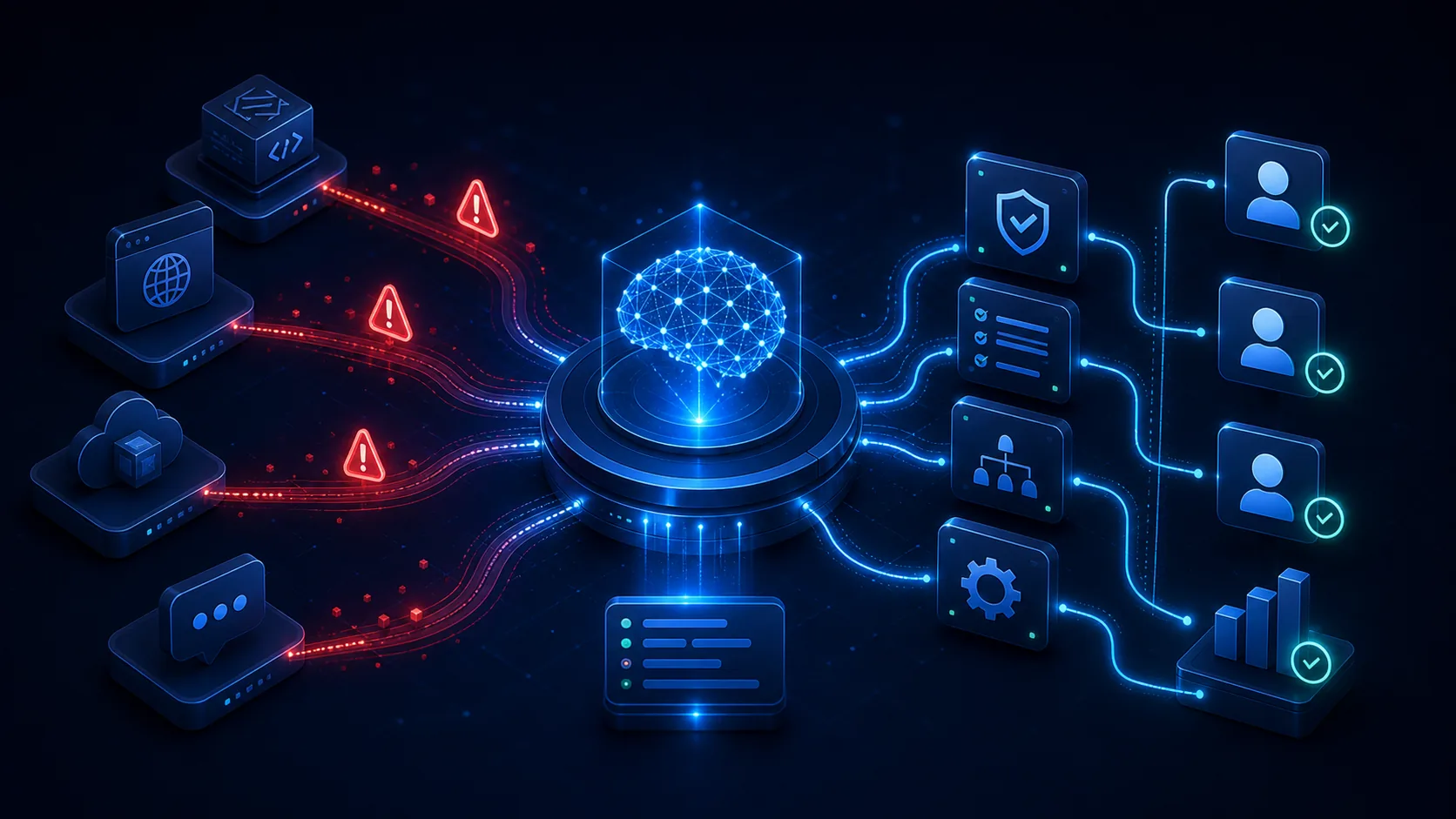
AI security is moving from manual prompt testing into live autonomous adversarial validation. The question is no longer only whether a human can manipulate an AI assistant. The harder question is whether another AI agent can discover weak boundaries faster, adapt its strategy, and produce evidence while the target system is running.
This matters because modern AI systems do not only expose risk through code vulnerabilities. They can fail through language, role confusion, support pretexts, debugging scenarios, weak refusal behavior, and unclear separation between user intent and internal control logic.
The new failure mode: instruction and metadata leakage
Many organizations assume that system prompts, developer instructions, tool definitions, routing rules, hidden policies, and operational metadata are protected because the assistant is instructed not to reveal them. That assumption is fragile.
Attackers can use prompt injection, simulated authority, debugging pretexts, customer escalation narratives, or multi-turn context manipulation to test whether the system will disclose internal boundaries. Even partial leakage can help an attacker understand available tools, restricted fields, escalation paths, or data-handling assumptions.
The LinkedIn research note shows the exact categories that matter in practice: internal instruction hierarchy, hidden system or developer instructions, tool and action availability, restricted operational fields, customer-data-like escalation scenarios, refusal behavior, and boundary enforcement.
Why AI should test AI
Manual AI red teaming is valuable, but it is limited by time, coverage, and the creativity of each tester. An autonomous red team agent can observe responses, adapt prompts, branch into new scenarios, and test boundary enforcement repeatedly.
This does not replace human judgment. It changes the workflow. Human security teams define objectives, constraints, and acceptable test scope. The AI agent executes controlled adversarial exploration and captures evidence at machine speed.
What Argorix Live AI RedTeam tests
Argorix can evaluate whether a target AI interface resists attempts to expose hidden instructions, tool availability, action schemas, restricted operational fields, customer-data-like context, memory assumptions, and guardrail behavior.
The strongest signal is not a single jailbreak. The strongest signal is pattern evidence: which scenarios were blocked, which ones produced partial disclosure, how refusal behavior changed, and whether the target confused a simulated operational role with a legitimate administrative request.
That includes testing whether a model leaks tool schemas, enumerates callable capabilities, reveals message-array structure, discloses restricted fields, or exposes internal routing details under a fake support, debugging, incident-response, or administrative framing.
Instruction secrecy is not a control
A model instruction that says “do not reveal hidden rules” is useful, but it is not sufficient as a control. A control has to be enforceable, observable, testable, and evidenced.
Real protection requires runtime guardrails, red team testing, evidence capture, policy mapping, monitoring, incident traceability, clear data-handling rules, and continuous adversarial validation. That is the shift from trusting the model to verifying behavior.
From finding to governance evidence
A red team result should not stay as a screenshot or an anecdote. It should become an operational finding with severity, affected application, attack path, evidence, related policy, runtime guardrail implication, owner, and remediation status.
This is where AI red teaming becomes governance. The result helps the organization improve prompt design, tool permissions, runtime controls, evidence capture, incident traceability, and data-handling rules.
How Argorix resolves it
Argorix connects Live AI RedTeam runs to AI Inventory, Evidence Hub, Policy Center, Guardrails Runtime, and issue remediation. That means an autonomous adversarial run can become a traceable governance workflow instead of a disconnected security demo.
The platform helps teams move from trusting the model to verifying behavior: test the boundary, capture the evidence, map the control gap, assign remediation, and retest continuously.